Kiama’s cliffs — genuinely among the most dramatic coastal formations in the region — are an embarrassment of photographic riches. Towering rock faces, sculptural geology, light that refuses to stay still… these are frames that don’t politely ask to be shot; they demand it. Stand close enough and the coastline feels less like scenery and more like a performance.
At Ridgewaters Kiama, we’ve positioned ourselves as the practical, perfectly located base for photographers who mean business. Chasing golden hour? Hunting hidden formations? Everything you need is within reach — gear, access, and the kind of comfort that keeps you out shooting when the light finally gets serious (because the good shots rarely wait for convenience).
What Makes Kiama’s Cliffs Stand Out for Photography
Geological Formations That Demand Your Lens
Kiama’s coastline features layered sedimentary formations – think natural striations, texture, and depth stitched into the rock face. These aren’t flat, forgettable walls; they’re sculpted canvases that reward attention. Catch them in golden hour… roughly 6:30–7:00 AM and again 5:00–6:00 PM (season will tweak that) – the low sun deepens shadows, carves the striations, and turns the geology almost theatrical. Some stretches wear iron-oxide like lipstick – orange, rust-red, glowing under warm light – while others are basaltic and near-black, offering brutal contrast. Translation: you’re not going to shoot the same cliff twice. Each segment of coast asks for different exposure decisions and composition approaches – and you’ll be glad it does.
Lens Selection and Vantage Points
Want the drama? Go wide – 16–35mm swallows scale, especially when you drop your vantage to the waterline and let the cliffs loom. Want intimacy? Grab 70–200mm – it isolates patterns and textures, lets you tell the cliff’s micro-story without the whole landscape. The choice between those focal lengths is not technical masturbation – it literally shapes how the viewer experiences the place (small and awed vs. close and forensic). Get low, play with diagonal lines, and don’t be shy about leaning into foreground elements to give the frame a heartbeat.
Tidal Patterns and Coastal Conditions
Low tide is your friend – it reveals extra rock, gives you wet-sand reflections, and extends compositional options. Check tidal charts (NOAA Tides & Currents) before you plan – Kiama’s best low-tide windows usually line up with those golden-hour windows anyway, which is convenient and not a coincidence. Afternoon winds are consistent and often fierce, so bolt down your tripod – use a wind-rated model – and keep a lens cloth handy for salt spray.
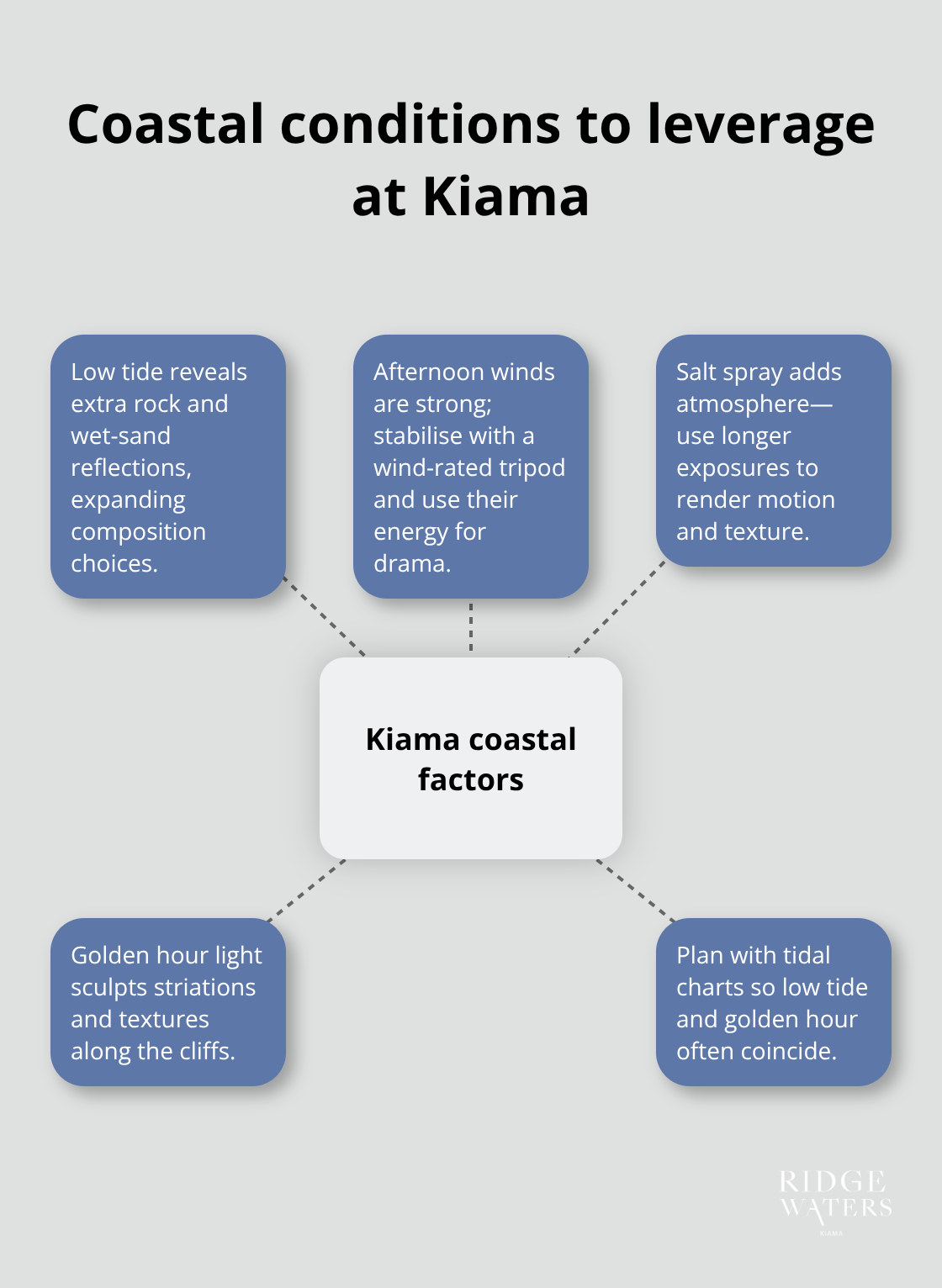
That spray? Don’t curse it – use it. Longer exposures (1–2 seconds) render spray into motion and atmosphere; static shots miss that texture.
Kiama’s cliffs are delightfully unpredictable – and learning to work with that unpredictability is the gap between competent coastal photography and something that actually makes people stop scrolling.
How to Shoot Kiama’s Cliffs Like You Mean It
Position Yourself for Maximum Impact
The gap between a forgettable snap and a photograph that hauls people up short is tiny – and entirely deliberate. Three decisions do the heavy lifting: where you plant your feet, what settings you choose, and how you respect (or ignore) the cliff’s unforgiving physics. Kiama doesn’t reward indecision – light flips in minutes, wind arrives like an unpaid intern, and if you’re fiddling with dials instead of watching the scene, you’ll miss the frame. Shooting from the cliff top and pointing down? Lazy. Move to the waterline or find a lower perch and let the cliffs dominate the frame – instant scale, instant drama. Don’t stand directly under a formation; move sideways so the ridgeline slices diagonally through the image and drags the eye along. That diagonal is your narrative.
Choose Your Lens and Focal Length Strategically
Wide-angle (16–35mm) makes you feel small – which is often the point. Want grandeur, go wide. Want detail – the layers, the rust-red streaks, the weathered basalt – pick a 70–200mm and tell a tighter, more intimate story. The compositional rule that matters here isn’t some vague aesthetic; it’s leading lines: water’s edge, a rock shelf, a diagonal crack – use them to shepherd the viewer from foreground to cliff face. Foreground is non-negotiable at Kiama – a slick rock, a tide pool, a piece of driftwood in crisp focus gives the viewer something to stand on mentally before they look up at the cliff’s theatrics.
Master Exposure and Colour in Harsh Coastal Light
Shoot RAW – not optional. The contrast between black basalt and bright, reflective water is a tone-eating machine; JPEG loses that battle. Bracket exposures: one at meter, one stop down, one stop up – blend later or pick the keeper that holds detail. A graduated neutral density filter tames the sky without killing the rock – keeps water from turning into a muddy grey smear while the sky blasts out white. Polarisers cut water glare and coax colour out of wet stones and pools – the effect is immediate and dramatic, so test it before you commit.
Set Your Camera for Kiama’s Conditions
Start ISO 100–200 (Kiama gives you plenty of light), aperture f/8–f/16 (so foreground and cliff share focus), and choose shutter speed for the water mood you want. 1–2 seconds softens wave action into cinematic motion without making the sea a blank. Use a robust, wind-rated tripod – Kiama’s afternoon gusts will ruin a shot and your temper.
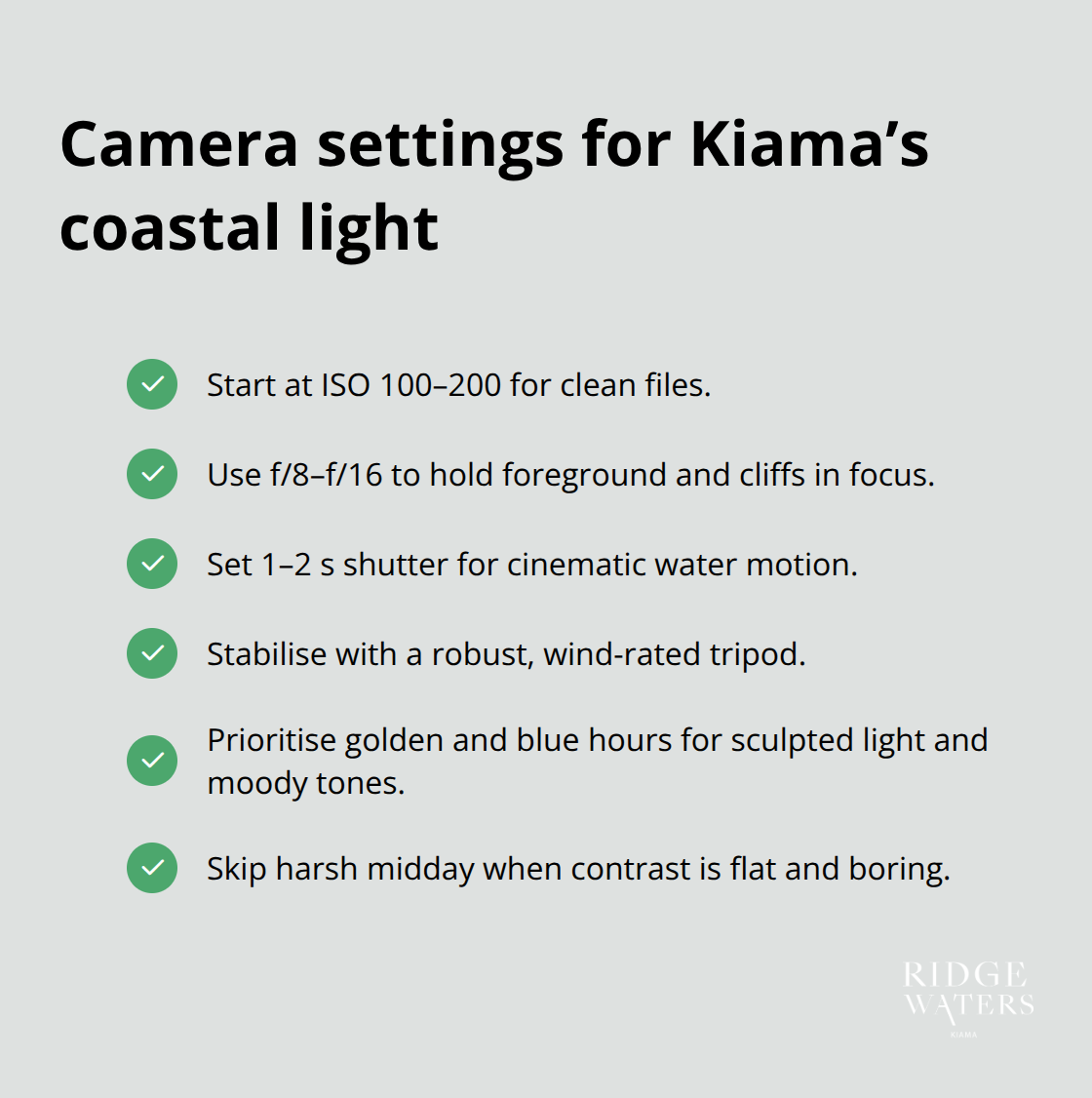
Golden hour (roughly 6:30–7:00 AM or 5:00–6:00 PM, season-dependent) sculpts texture and shadow; blue hour (about 20–40 minutes after sunset) brings moody cool tones that work for silhouettes. Midday? Skip it. The sun up high eats contrast and flattens everything into boring.
Prioritise Safety and Gear Protection
Stay back from the lip – slick rock, surprise gusts, and waves that climb higher than you think are the usual suspects, not rare events. Shoot with a partner (don’t be a lone cowboy) so someone can watch your back while you’re lost in the viewfinder. Use a wind-proof tripod and sandbag the legs in extreme conditions. Keep a lens cloth handy – salt spray loves to coat glass, and a few seconds of buildup nukes sharpness. Bring a charged spare battery and a full phone (coastal conditions sap power faster than you expect) – and if something goes sideways, you want to call for help. Wear grippy footwear, check tide charts (don’t tempt fate at high tide), and trust your gut – if it feels unsafe, it is. The light will come back. With those basics dialled, you’re free to stop obsessing about technique and start exploring what makes Ridgewaters Kiama a brilliant base for extended cliff work.
Why Ridgewaters Kiama Works as Your Cliff Photography Base
Location and Access to Multiple Formations
Kiama sits 90 minutes south of Sydney-close enough to bolt out of the city but far enough to dodge the tourist stampede that ruins better-known coastlines. That proximity is tactical. Base yourself at Ridgewaters Kiama-a luxury apartment complex with secure parking and private lift access-and you can hit multiple cliff formations within 20–40 minutes of your door. No commutes that burn daylight.
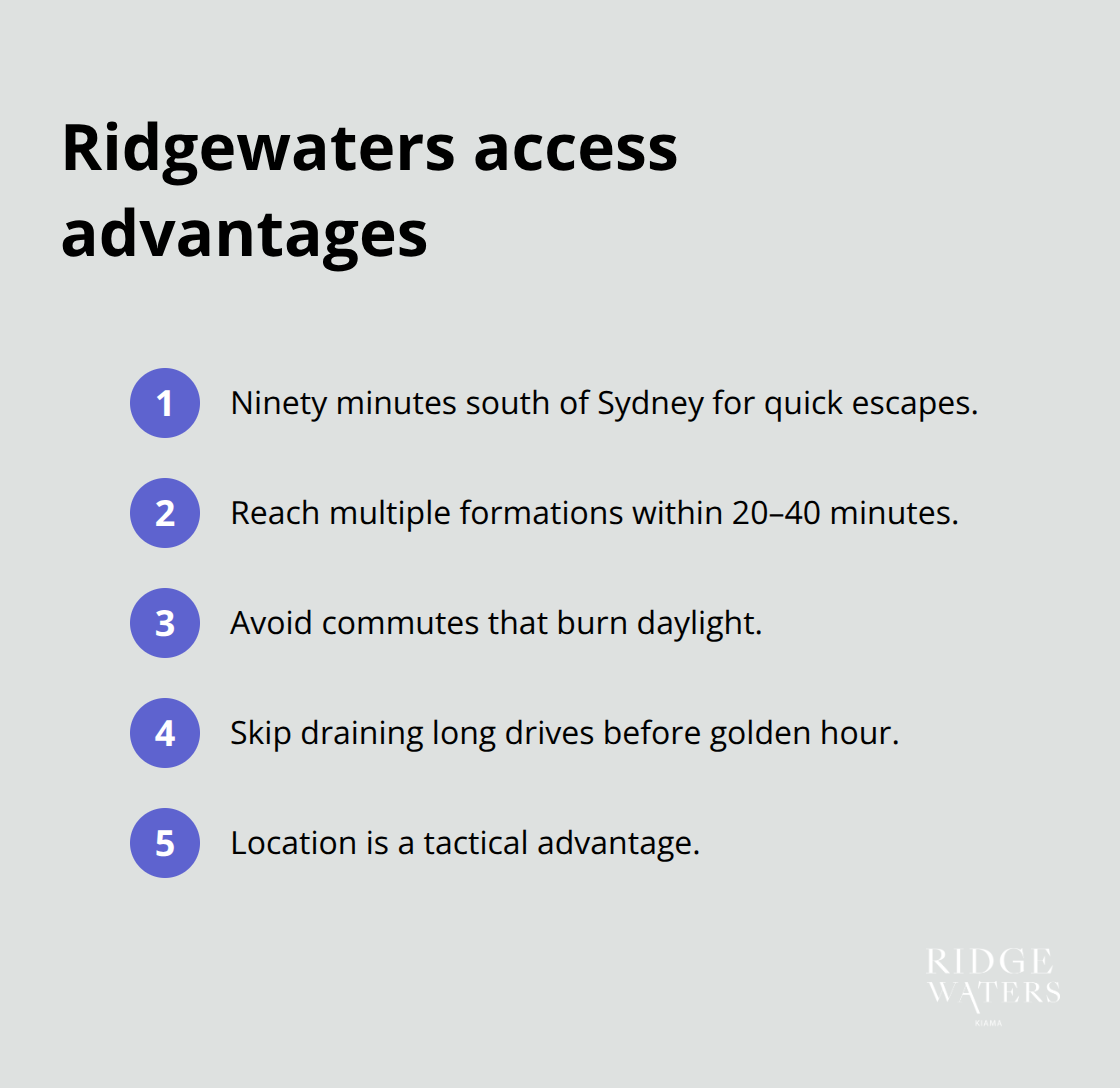
No draining drives that have you arriving to golden hour already depleted.
The coastline here is a compact buffet of geology-orange iron-oxide striations that sing under warm light, basalt cliffs that throw brutal contrast against sky and surf. It isn’t one monolithic coastline-think micro-environments stacked like playlists. Low tide exposes different compositions at different spots; wind flips based on which face the cliff shows; light angles migrate as you move north or south. In short: variety without the travel penalty.
Tactical Advantages of a Beachside Base
Ridgewaters Kiama works as your operational hub between shoots. Luxury digs let you rest, charge batteries, offload cards, and review the morning’s kills (or misses) without wasting afternoon light on hotel commutes. That’s not fluff-serious shooters know the difference between good light and great light is often 20 minutes and a five-minute reposition. Start from 90 minutes away and you miss those micro-opportunities-game over.
Living beachside means you don’t just drop in; you live the coastline. You absorb the tidal rhythms, the wind quirks, the light shifts across days. That familiarity yields decisions that matter: which formation bites golden hour best, where the spray thickens, how the rocks behave at different tides. The coastal lifestyle isn’t decoration-it’s embedded reconnaissance.
Extended Cliff Work Without Logistical Friction
Weekend sprint or a two-week deep dive-Ridgewaters Kiama removes the logistical frictions that wreck most photo trips. Shoot the same morning two different ways at two different locations-exactly what extended cliff work demands. You’re not forced to replay the same frame because you’re marooned at one spot. Move fast. Reset. Chase the light. The best images come from iteration-and Ridgewaters lets you iterate without the admin overhead.
Final Thoughts
Kiama’s cliffs reward shooters who commit – not the drive-by snap crowd, but the people who learn the tide charts and live the coastline’s rhythms. Geological variety, tidal rhythms, shifting light across hours and seasons… these aren’t academic advantages – they’re the day-to-day conditions of the job. They require preparation, patience, and iteration. Photographers who base themselves here inhabit the shore long enough to read its moods (and to exploit them) – and those are the images that actually matter.
We at Ridgewaters Kiama built something deliberate – a beachside base that removes the friction between ambition and execution. Ninety minutes south of Sydney, you’re far enough from the city crush to find genuine solitude, yet close enough to avoid wasting daylight on commutes. Secure parking, private lift access, and luxury apartments designed for living between shoots are not frills; they’re operational necessities. They let you reset, review, and return to the water without losing momentum.
The Kiama cliffs won’t photograph themselves, and they won’t pause for perfect conditions – but they do reward shooters who show up prepared and stay flexible. Ridgewaters Kiama offers the luxury apartments and coastal access serious photographers need for extended cliff work. Whether it’s a focused weekend or a two-week deep dive into the formations, the infrastructure supports your ambition – and makes the good shots substantially more likely.