
Australia’s coastal property markets are crushing it right now — exceptional returns, real momentum. We at Ridgewaters Kiama have watched capital growth accelerate across the region, and investors are finally waking up to what’s been sitting in plain sight.
This blog post breaks down exactly why our development is capturing investor attention — and what the numbers actually show about returns in this market (no fluff… just the hard stuff investors care about).
Kiama’s Market Reality
Units Outpace Houses in Capital Growth
Units in Kiama have gained 14.4% over the past 12 months, according to Realestate.com.au data through January 2026 – and that number tells you everything you need to start paying attention. Contrast that with Sydney’s well-documented mood swings and you see clarity: money prefers predictability. Three‑bedroom units, the busiest segment, sit at a median of $1,180,000 and have climbed 13.5% year-on-year; two‑bedroom units are basically treading water at $835,000. Why care? Because this divergence is where investor capital actually flows – blunt and simple.
Three‑bedroom apartments attract families on school holidays and groups booking extended stays (think repeat bookings, less churn) – which explains why they’re resilient. Houses? A different weather pattern – prices have contracted 4.8% over 12 months, with three‑bedroom homes down 8.3%. The takeaway: apartments are hybrid assets – part long-term rental, part holiday-let – while standalone houses fight headwinds (higher maintenance, thinner tenant demand). That gap matters – it’s where opportunity and risk live.
Rental Yields Favour Apartments
The math backs the story. Units deliver about a 3.5% gross yield on average, three‑bedroom units hit 3.7%, houses drag at roughly 2.8%. Three‑bedroom houses command $788 weekly but turnover is slow; three‑bedroom units rent for about $750 weekly with a 22‑day median time‑to‑lease.
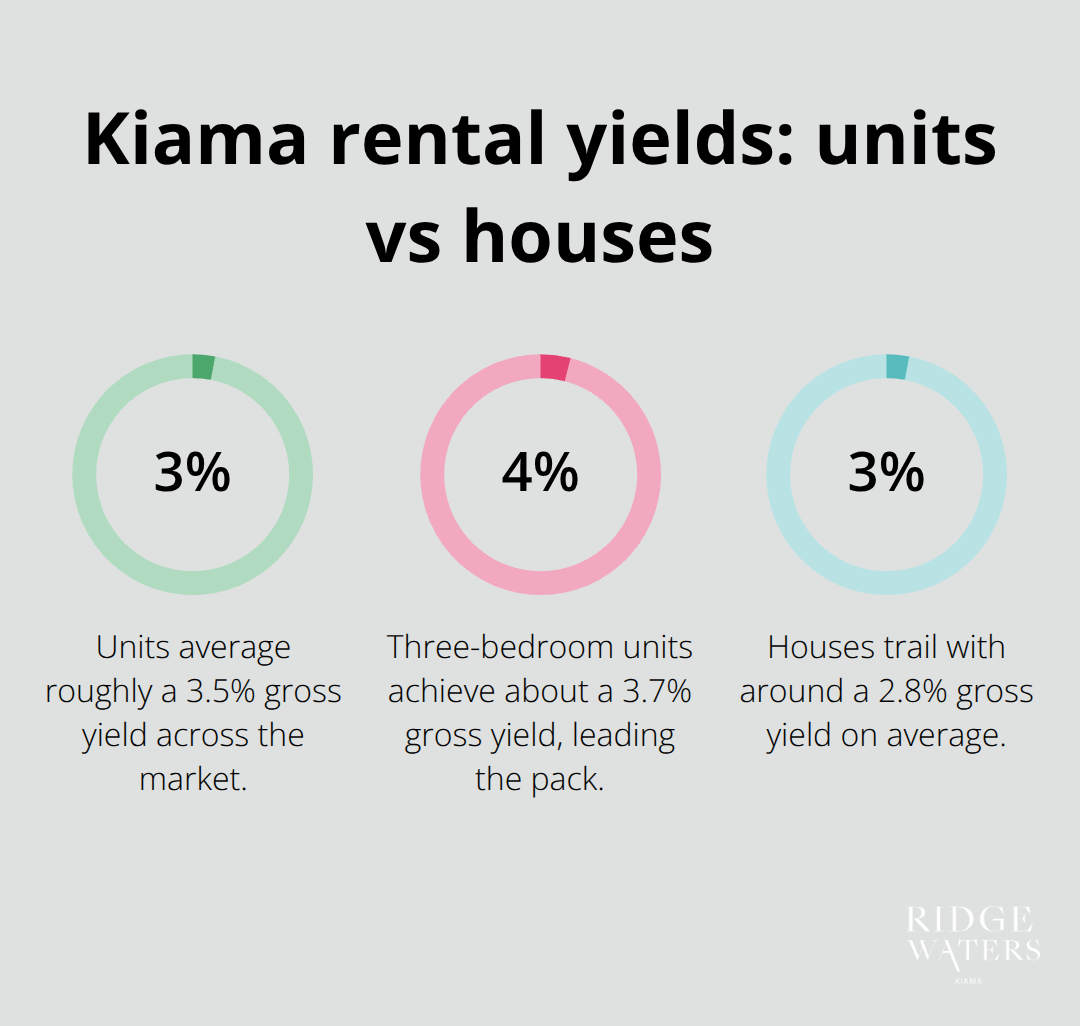
Translation: if your objective is cash flow – and most investors should at least care about it – apartments beat houses in Kiama, hands down. Numbers don’t lie – people do.
Seasonal Demand Amplifies Returns
Seasonal demand patterns in Kiama amplify the investment case further. Typical properties see occupancy near 34%; entry‑level listings sit closer to 18% – big spread. Ocean‑view properties command roughly a 35% premium over non‑view alternatives – that premium compounds over time (and it’s not noise). AirDNA shows Kiama’s Airbnb inventory grew 15% year‑over‑year – supply is rising, demand is holding. Guests average 5–7 nights and are mostly young professionals (25–40) plus international visitors from the UK and US. That mix = higher frequency, willingness to pay, and predictable seasonality.
Active Management Unlocks Premium Returns
Operationally, this tenant profile rewards active management: repeat bookings, better reviews when hosts provide beach gear and local guides, and a willingness to pay for convenience. Dynamic pricing tools – PriceLabs, Beyond Pricing – matter here. Flat rates leave thousands on the table during Easter, school holidays, and March events – that’s not theory, that’s forgone income. Investors who run bookings actively (or hire savvy property managers) convert seasonality into outsized returns versus the flat‑rate long‑term rental market across regional New South Wales. Bottom line: apartments in Kiama give investors optionality – and optionality, managed well, is worth a premium.
Why Ridgewaters Kiama Works for Multiple Investor Types
Kiama sits 90 minutes south of Sydney – the Goldilocks zone: close enough for weekend escapes and work-from-home bleisure, far enough to carry real scarcity. That proximity matters in practice. Sydney guests skip the congested Central Coast but don’t sign up for the logistical headache of a remote regional property. The data backs it – Kiama pulls 25–40-year-old professionals and international visitors from the UK and US, cohorts happy to pay a premium for convenience and vibe. A three-bedroom asking $1,080,000–$1,180,000 is priced at the luxury end of the local market, which means you can command $500–$700 a night in peak season – materially higher than typical regional listings. That price tag isn’t vanity; it reflects genuine demand from people who care about modern design and precise location.
Premium Amenities Drive Revenue Potential
Contemporary finishes aren’t aesthetics for Instagram – they’re revenue levers. Stone benchtops, European appliances, gas cooktops, floor-to-ceiling glass – these elements sell nights. Professional photos that highlight them outperform generic shots, period (property managers see this across coastal markets). Ducted air-con and private lift access reduce friction – no shared corridors, faster turnovers. EV chargers fill a real gap; and 43% of remote workers prioritise strong internet and modern infrastructure when picking stays (Deloitte). FTTP NBN up to 2000 Mbps?
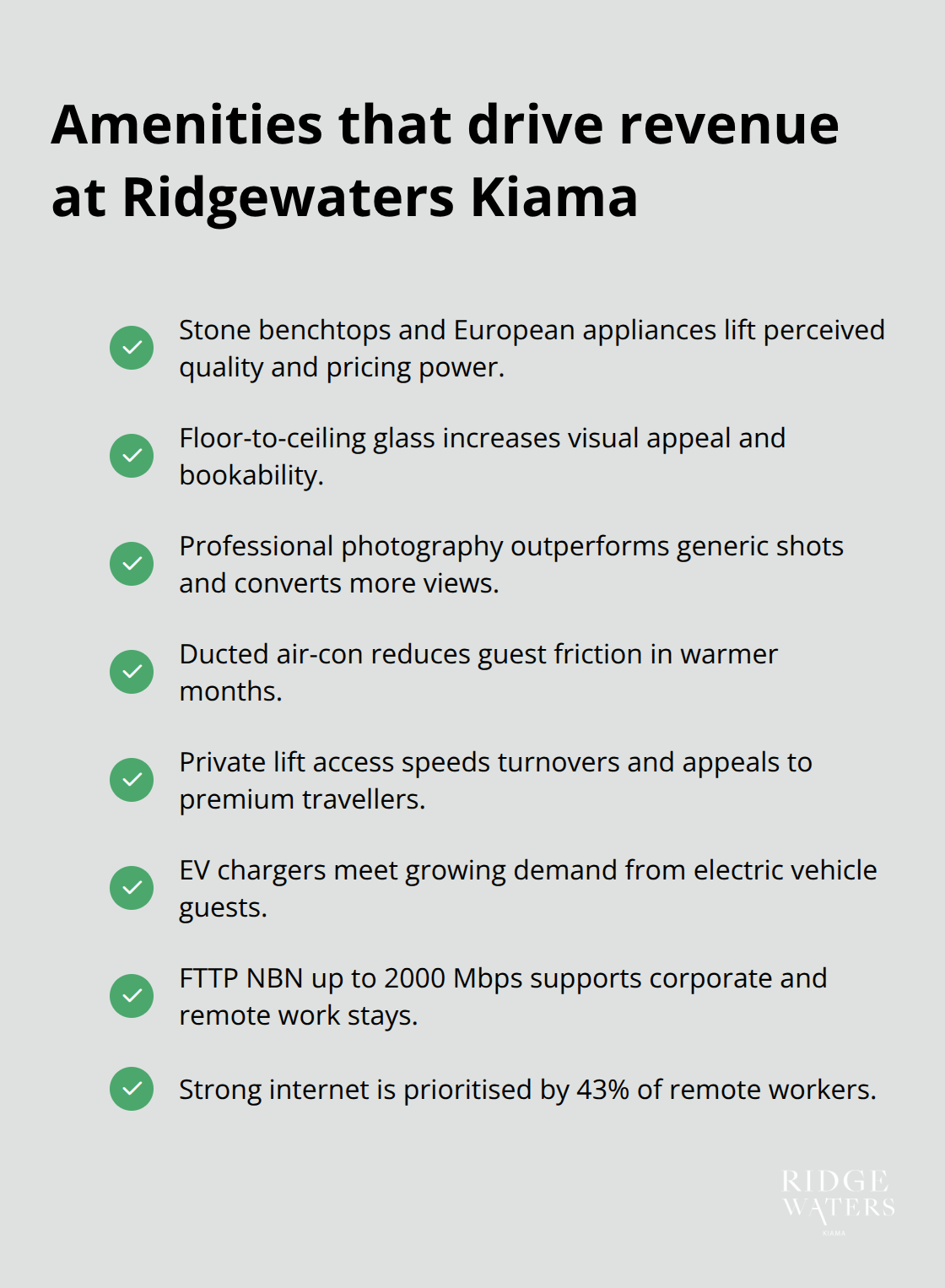
That’s not a checkbox – it’s a passport to midweek corporate bookings. Investors hosting business or extended-stay guests can push midweek rates north of $300 because the product actually meets needs, not developer assumptions.
Dual Income Pathways Create Portfolio Flexibility
Optionality is the edge. A three-bedroom nets roughly $750 per week on a long-term lease (Kiama median rents) – about $3,500–$4,200 monthly gross. Run it short-term in peak months and you’re looking at $500–$700 a night – translating to $15,000–$21,000 monthly across summer. Off-season falls to $200–$300 a night, but winter occupancy of 60–65% still delivers meaningful cash. Not comfortable with full-time holiday letting? Mix calendars: long-term September–March, short-term April–August (school holidays, Easter, summer demand) – hedge vacancy and capture seasonal premiums. That hybrid play is the practical advantage apartments have over standalone houses: flip between income strategies based on market rhythms and your risk appetite.
Active Management Converts Seasonality Into Returns
Dynamic tools (PriceLabs, etc.) let you tweak rates around events and weather without living in a spreadsheet. Owners who run this like a small business – beach gear, curated local guides, lightning-fast responses – see 20–30% better occupancy and review profiles than passive landlords (platform data). Dynamic pricing around Easter, school breaks and March festivals extracts thousands more than a flat-rate lease would. Kiama’s guest mix (young pros, internationals, families during school holidays) rewards that operational intensity – more bookings, more willingness to pay. The local apartment market gives you flexibility houses don’t: pivot income strategies when the market and your calendar say it’s smart.
Capital Returns and Income Strategies in Kiama
Price Growth Favours Three-Bedroom Units
Three-bedroom units in Kiama sit at a median price of $1,180,000 – and they’ve ripped 13.5% higher year-over-year through January 2026 (Realestate.com.au). That capital appreciation is sexy, sure… but the real story is income. Houses actually contracted 4.8% over 12 months while units climbed 14.4% – a 19-point spread that tells you where capital is voting with its wallet. The divergence isn’t random: investors prefer apartments – hybrid assets that work as steady long-term rentals or high-octane holiday lets – while standalone houses slog under higher maintenance and thinner tenant demand.
Long-Term Rental Income Establishes a Baseline
A three-bedroom apartment rents for roughly $750 a week on a long-term lease – about a 3.7% gross yield. That’s $3,500–$4,200 a month – boringly reliable income that builds a foundation for wealth. Ocean-view properties, per AirDNA data, sit in a higher income bracket – people pay for a view. Kiama’s guest mix (young professionals plus families on school breaks) rewards operational intensity and modern finishes – invest in thoughtful fixtures and you get to charge more.
Short-Term Rental Transforms Income Potential
Switch to short-term rentals and the math changes – dramatically. Summer nightly rates run $500–$700 with occupancy up around 90%; even winter, with 60–65% occupancy at $200–$300 a night, still produces meaningful cash flow. Active short-term management can generate $15,000–$21,000 monthly in peak season, versus $3,500–$4,200 from a long-term lease. That delta explains why apartments beat houses in Kiama. Developments like Ridgewaters Kiama – floor-to-ceiling glass doors and balconies – are built to capture that premium (ocean view = pricing power).
Dynamic Pricing Maximises Seasonal Demand
Dynamic pricing tools – PriceLabs, Beyond Pricing – aren’t optional if you want to maximise returns. Landlords who post flat rates in Kiama are literally leaving thousands on the table around Easter, school holidays, and March events when demand spikes. Active management also means beach gear, curated local guides, and sub-30-minute response times – platform data shows hosts who do this enjoy 20–30% better occupancy and review scores than passive landlords.
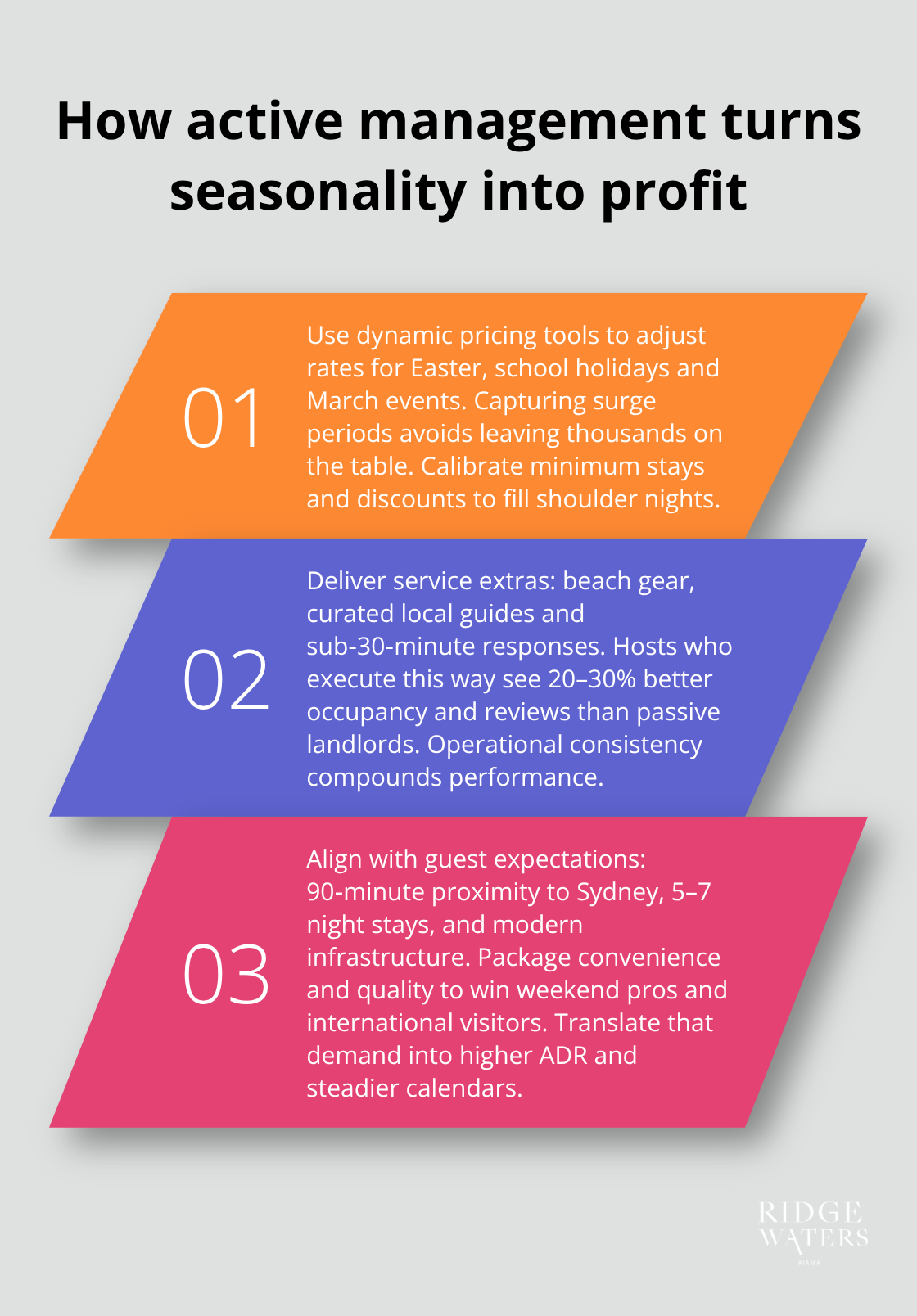
Kiama’s 90-minute proximity to Sydney is a sweet spot – close enough for weekend professionals and international visitors (mainly UK and US) who stay 5–7 nights and expect modern infrastructure, not a discount shoebox.
Dual Income Pathways Build Wealth Faster
Wealth compounds when you get both capital appreciation and cash flow working together. Three-bedroom units appreciating at 13.5% annually plus $750–$1,050 weekly rental income (depending on how aggressively you manage) create a dual-return engine houses struggle to match. Smart investors pivot – long-term September–March, short-term April–August (school holidays, Easter, summer) – and capture seasonality premiums regional house markets can’t offer. Flexibility is the practical advantage apartments hold: hedge vacancy, harvest demand spikes, and extract maximum returns from market rhythms.
Final Thoughts
Three‑bedroom units in Kiama have been compounding like a quiet disruptor – 13.5% annual appreciation and roughly 3.7% gross rental yields. That combo? Houses in the region simply don’t come close. The numbers aren’t opinion – they’re a headline: units outpace houses, apartments beat standalone properties, and active, thoughtful management turns seasonality from a bug into a feature (translation: measurable returns).
What makes Ridgewaters Kiama interesting isn’t hype – it’s product. Floor‑to‑ceiling glass doors, stone benchtops, European appliances, private lift access – those are not throwaway features; they justify premium pricing in a market where ocean views pull about 35% higher nightly rates than the no‑view alternatives. Simple economics – better product, better price.
Cash flow looks different depending on your play. Long leases: steady income – about $750 per week. Short stays: the upside is real – $15,000–$21,000 a month in summer. Blend calendars based on market signals and your risk appetite, then lean on dynamic pricing to squeeze extra revenue around Easter, school holidays and March events. Kiama’s guests – young professionals and international visitors averaging 5–7 nights – reward operational intensity and contemporary finishes in a way that capital growth alone cannot.
Capital growth, cash flow, and optionality converge at Ridgewaters Kiama. If you’re serious about coastal property returns, the numbers deserve a closer look.