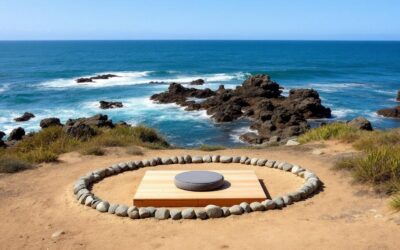
Coastal vegetation — not kerb appeal, not an accessory — it’s the backbone of beautiful, sustainable communities. At Ridgewaters Kiama, we didn’t slap on plants for a photo op. We built our landscaping philosophy around native species that actually belong here…that thrive in the salty wind, the sandy soil, the local rhythm.
They’re not just pretty — that’s the easy part. These plants cut maintenance, sip far less water, and harden the coastline against whatever the weather throws at us. Practical, efficient, resilient — the trifecta. Bottom line: native species aren’t a trend; they’re quietly reshaping how we live on the coast. Discover why.
Why Native Plants Win on the Coast
Salt Spray, Sandy Soil, and the Native Advantage
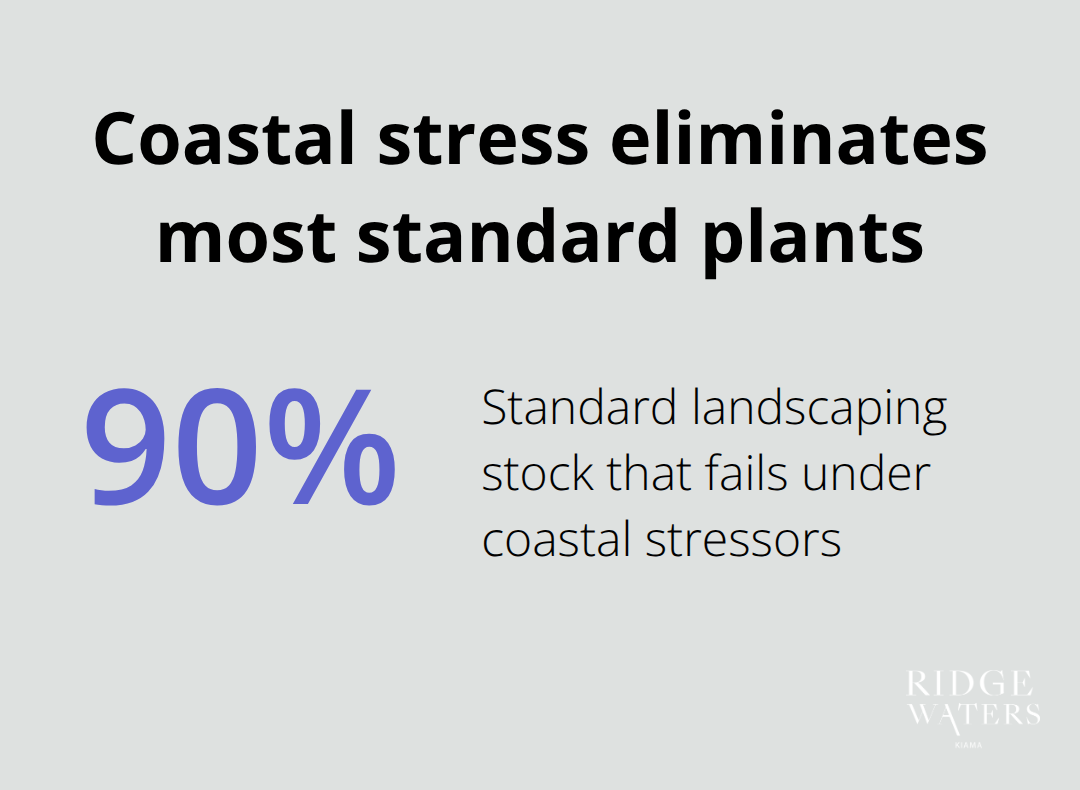
Salt spray kills most plants. Sandy soils drain like a sieve. Humidity breeds fungal problems. These aren’t annoyances-they’re deal-breakers for roughly 90% of standard landscaping stock.
Native coastal species evolved under those exact assaults – simultaneously – which means they establish faster, need less babysitting, and (this is the kicker) improve over time instead of collapsing into a sad, expensive shrub graveyard. Acacia sophorae and Leucopogon parviflorus aren’t guesses-they’re survival blueprints. Their roots, leaves, growth rhythms were forged where your Kiama garden actually lives. This isn’t marketing copy – it’s 10,000 years of natural selection doing the heavy lifting for you.
Water Efficiency and Soil Stability
Natives sip – not guzzle. They use 40–60% less water than exotic alternatives because they’re tuned to local rainfall and soil moisture rhythms. That matters in Kiama – water restrictions, rising bills, the usual coastal realities. Deep, fibrous roots anchor sand and slow erosion (translation: your property edge stays intact). Those root systems also improve sandy soils, so the benefits compound year after year – lower utility bills, less strain on local systems, and a landscape that pays dividends rather than demanding them.
Lower Chemical Inputs and Natural Pest Control
Plant natives and maintenance falls like a stone: fewer fertilisers, fewer pesticides, fewer sleepless nights fighting diseases exotics invite. Native pollinators (think native bees and birds) show up when they recognise plants – and once they’re back, they do the job. Blue-banded bees boost nearby fruit and veg productivity; native birds keep insect pressure down. The math is simple – less irrigation, fewer chemicals, less labour – equals lower real costs and a garden that functions as an ecosystem, not a project.
Coastal Resilience and Long-Term Property Protection
Coastal erosion control stops being a checkbox and becomes a bonus when you use native coastal plants to stabilise edges and protect long-term site stability against climate swings. Biodiversity isn’t just pretty – it’s structural integrity for your land. These plants don’t merely survive the coast; they improve it. Knowing which natives actually thrive in Kiama’s microclimate keeps you from throwing money at the wrong shrubs and sets you up with species that protect value – and probably your sanity – over decades.
The Best Native Plants for Kiama’s Coastal Environment
Coastal Workhorses: Acacia and Leucopogon
Acacia sophorae and Leucopogon parviflorus are the backbone of Kiama’s coastline – not glamorous, but absolutely reliable. Coastal wattle establishes fast in sandy soils and shrugs off salt spray; once it’s rooted, you can nearly forget about irrigation. It also fixes nitrogen – so your sand slowly becomes actual soil without you dumping fertiliser on it. Coast beard-heath? It’s the pollinator party host – native bees and birds love it – and it tolerates the exact salt-laden winds that flatten most ornamentals.
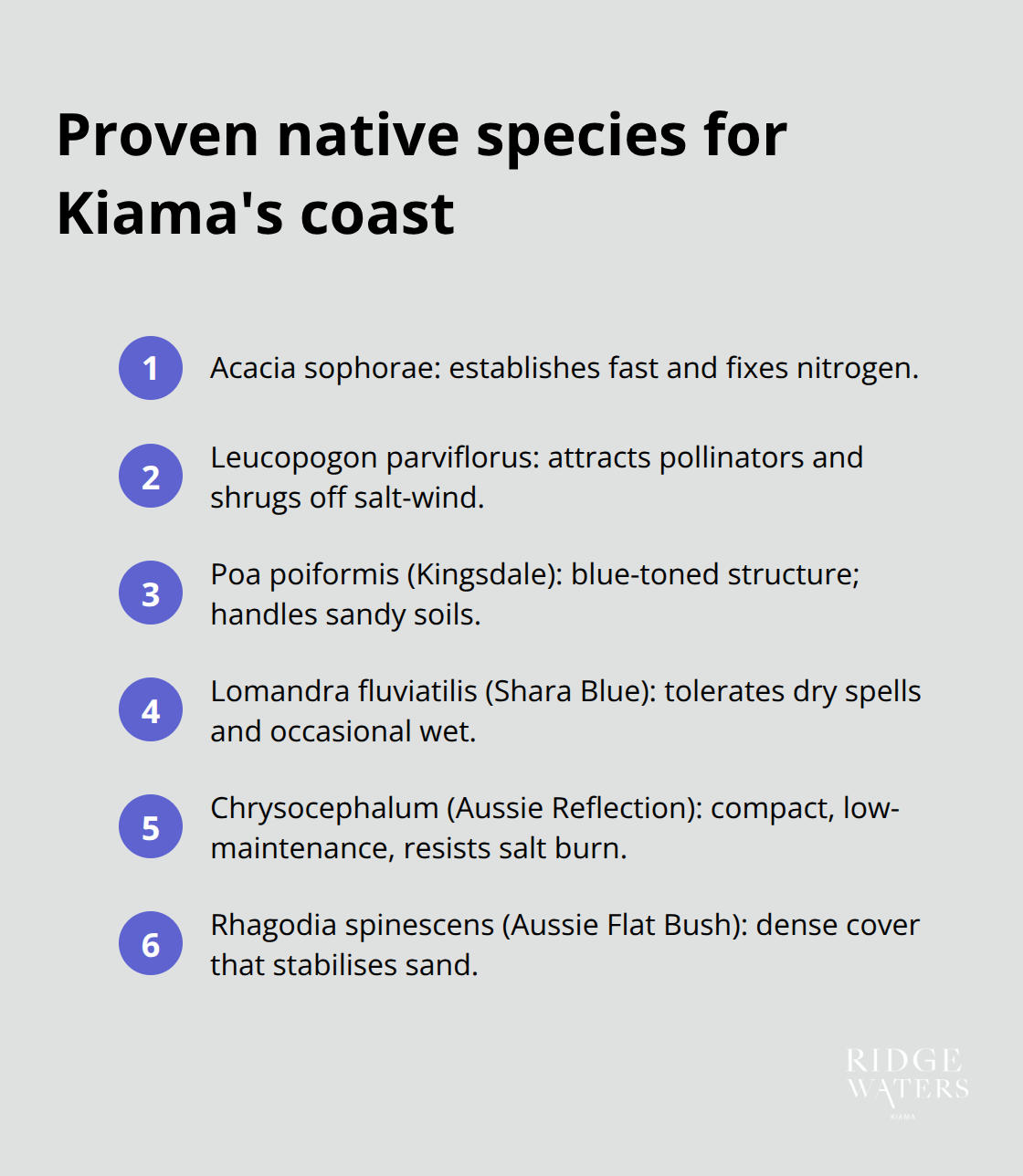
Plant them together in layers: the wattle gives height and a windbreak, the beard‑heath fills the gaps with flowers that actually mean something to the local ecosystem.
Grasses and Ground Covers That Handle Coastal Stress
Poa poiformis (Kingsdale) brings blue-toned structure with arching foliage that tolerates sandy substrates like it’s no big deal. Lomandra fluviatilis (Shara Blue) is the Swiss Army knife – copes with dry spells and the occasional soggy patch, so it’s useful across Kiama’s microclimates. Chrysocephalum (Aussie Reflection) and Rhagodia spinescens (Aussie Flat Bush) give you compact, low-maintenance coverage that resists salt burn and won’t dominate a small courtyard. No staking, minimal pruning, dense roots – they stabilise sand and reduce erosion – which, in a coastal property, is a huge practical win (wind and weather are relentless).
Shrubs and Trees for Screening and Structure
Callistemon viminalis (Better John) is a proven coastal screen – bold blooms, salt-tolerant – but it wants full sun to look its best. Correa alba (Coastal Pink) stands up to relentless wind and gives you seasonal pink flowers without asking for rich soil or daily attention. Westringia fruticosa (Grey Box) makes excellent hedging – drought-tolerant, compact, dense – and it blocks wind without the brittle drama of many exotics. Metrosideros collina (Velvet Sky) brings theatrical colour – inky blue stems, foliage that deepens in shade – so you get variation without the risk of importing a diva species that will fail.
Matching Plants to Exposure Levels
Here’s the practical truth: success vs. failure on a Kiama site usually comes down to two things – root depth and salt tolerance. Frontline positions want deep-rooted species like Acacia sophorae; secondary, filtered-wind spots are where shallower species like Correa alba belong. Planting a wind-sensitive shrub in full salt spray is a waste – money down the drain and maintenance headaches to follow. Pick natives for the specific exposure (not just because they look pretty) and you’ll get landscapes that last – lower water bills, almost no chemicals, and less grief. Then think about layering – visual depth, functional resilience – that’s how you make the whole property hold up to wind, salt, and time.
Design That Pays for Itself
Contemporary Aesthetics Meet Coastal Practicality
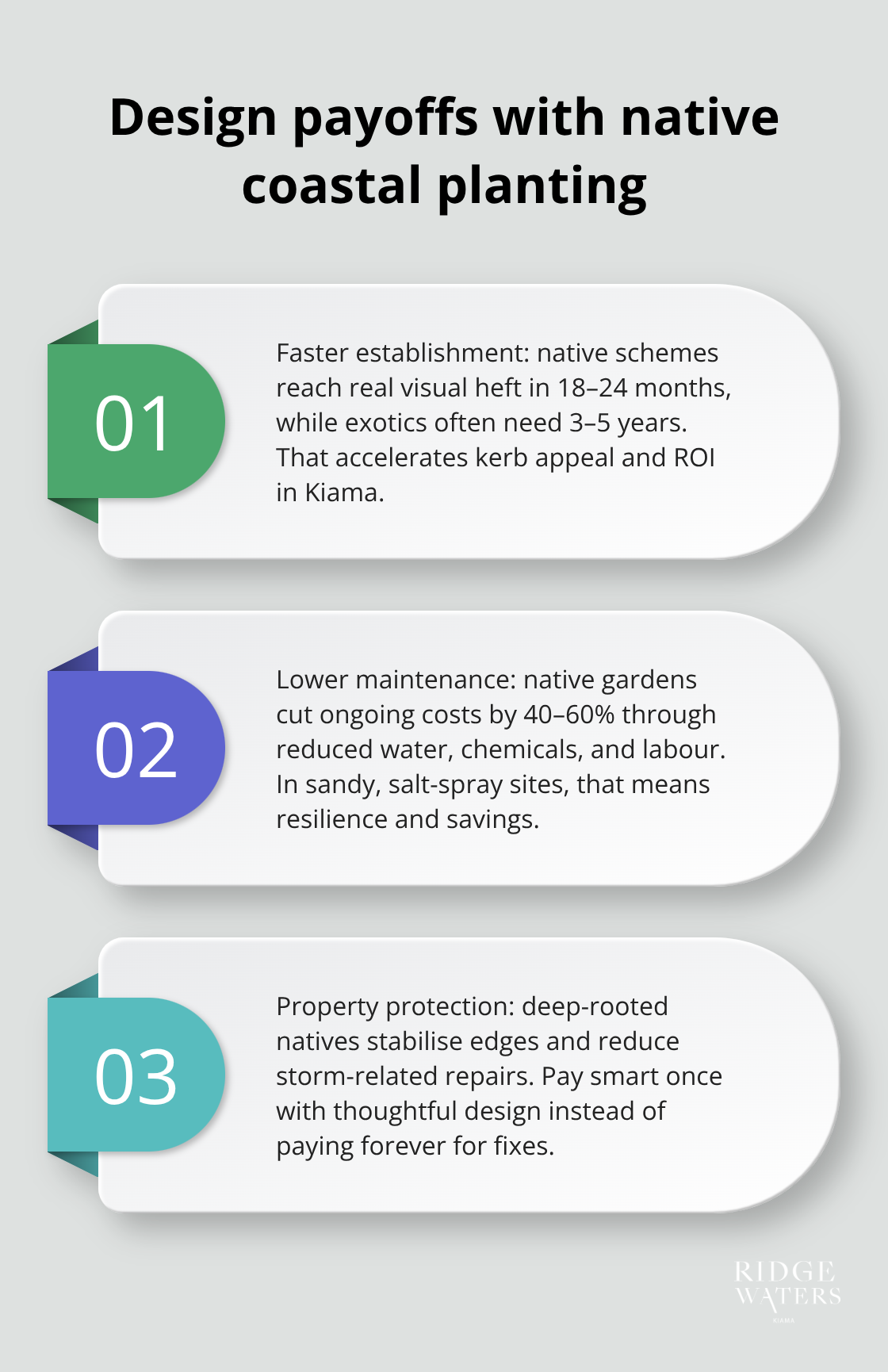
Native coastal plants do more than look pretty-they rewrite the economics of your property. The cool-toned palette everyone’s slathering across coastal landscapes-blues, grey, silvers-actually pairs perfectly with natives like Poa poiformis and Lomandra fluviatilis, producing a contemporary vibe that reads calm, intentional and not “trying too hard.” That matters because in coastal markets like Kiama, kerb appeal and landscape maturity move price tags faster than any glossy kitchen. Native schemes establish quicker than exotic mixes-think 18–24 months for real visual heft versus the 3–5 years most ornamentals demand. Translation: impact arrives sooner, which matters if you’re eyeing short-term Airbnb returns at Ridgewaters Kiama (first impressions = bookings… and sales interest).
Maintenance Costs Drop Dramatically
Native coastal gardens shove maintenance costs way down-40–60% lower than exotic-heavy designs-because you’ve removed the usual cost-drivers: water compliance headaches, chemical cocktails, and endless pruning labour. Plants like Callistemon viminalis (Better John) and Correa alba are basically low-maintenance assets-no staking, no fungicides, no seasonal babysitting. In Kiama’s sandy soils and salt-spray winds, that’s not a nicety; it’s survival economics. Choose natives and your garden compounds value; pick exotics and it slowly drains cash through preventable failures.
Property Protection and Structural Resilience
Deep-rooted natives-Acacia sophorae, for example-stabilise property edges and protect structures from coastal weather’s worst moods. That kind of frontline resilience has real-dollar consequences-fewer landscape repairs, less soil remediation, fewer emergency fixes after a blow. Native plantings essentially front-load stability-pay smart once (thoughtful design) rather than paying dumb forever (reactive repairs). Buyers see that equation: lower ongoing costs, sophisticated visuals, and a landscape that actually survives the coast. Those properties command measurable premiums-because in real estate, reliability sells.
Final Thoughts
Native coastal vegetation – not a manicured lawn with coastal-themed accessories – is the foundation of how we at Ridgewaters Kiama actually build communities that work on the coast. Plants that tolerate salt spray, sand and wind protect property value, slice ongoing costs, and create places people want to live. Whether you’re here full-time, renting short-term, or weighing an investment – your surroundings shape your days (and your wallet).
Species like Acacia sophorae and Leucopogon parviflorus function as infrastructure – they stabilise edges, feed local pollinators, and establish far faster than the imported alternatives. The payoff is tangible: lower water bills, minimal chemical inputs, and landscapes that improve with time instead of devolving into endless maintenance (the kind that eats weekends). When your landscape works with the coast – instead of against it – you get back time to enjoy Kiama’s beaches, trails and community life.
Sustainable coastal living demands plants that belong here, perform reliably, and strengthen over decades. Cool-toned native palettes deliver the calm, intentional aesthetic coastal buyers expect – and the resilience properties actually need. Explore how Ridgewaters Kiama integrates native coastal plants into every community we develop.